Basic HTML Version


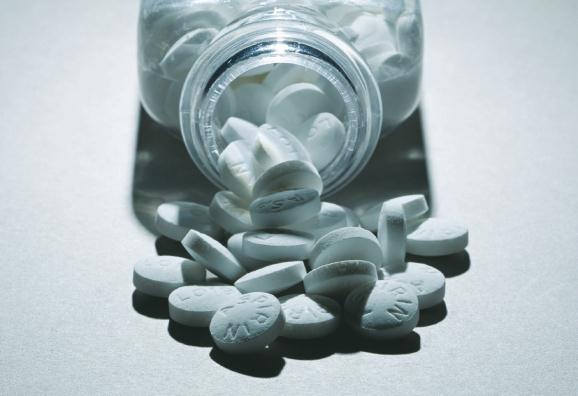
Weighty matters
YOU PROBABLY HAVE a bottle of aspirin
tucked away somewhere in your house. It
may be in the back of the bathroom medicine
cabinet or in the kitchen junk drawer. You
know it’s there somewhere, ready to bring
relief the next time you have a headache or
some other minor pain.
But maybe it’s time to rescue that dusty
bottle from its obscure hiding place. As it
turns out, those unassuming over-the-counter
pills may offer health benefits that go beyond
traditional pain and fever control.
Heart attack and stroke
Research shows that for certain people,
aspirin can help reduce the risk of heart
attack and the most common type of stroke,
two of the top causes of death and disability
in the United States.
How aspirin accomplishes this feat isn’t
completely understood. Apparently, it does
that through its ability to prevent platelets in
the blood from clumping together. That helps
keep blood flowing smoothly to the heart and
brain. When blood flow is blocked, it can lead
to a heart attack or stroke.
Men and women
Aspirin’s protective benefits differ for men
and women. According to the Agency for
Healthcare Research and Quality (AHRQ),
aspirin generally helps men lower their risk
of heart attack and women lower their risk of
stroke.
Because of this, the AHRQ recommends
that:
■■
Men ages 45 to 79 ask their doctor about
taking aspirin to protect against a heart
attack.
■■
Women ages 55 to 79 ask their doctor
about taking aspirin to protect against a
stroke.
You and your doctor
A doctor’s advice is important. That’s
because, as with all medicines, aspirin’s
potential benefits come with some possible
risks.
For example, some people who take
aspirin have bleeding in the stomach. Others
suffer a rare type of stroke. Your doctor
can help you decide if you should be taking
aspirin regularly.
Also, he or she can guide you in selecting
the proper dose of aspirin. Recommendations
often involve taking an 81 mg (low-dose)
aspirin each day or a 325 mg (regular-dose)
aspirin every other day.
Looking for a physician? To find a
PeaceHealth provider who’s right for
you, call
541-743-4600
.
Aspirin:
Benefits
vs. risks
Even though aspirin can
help some people avoid a
heart attack or stroke, it’s not
for everyone.
Taking aspirin regularly
has been linked to a number
of serious side effects,
such as kidney failure and
bleeding in the stomach and
brain, reports the U.S. Food
and Drug Administration
(FDA).
Also, several over-the-
counter and prescription
medicines have blood-
thinning properties just like
aspirin. Taking these drugs
with aspirin can be risky.
That’s also true of certain
vitamins, herbal remedies
and supplements.
According to the FDA,
regular aspirin use may not
be a good idea for people
who have:
■■
A bleeding disorder.
■■
Uncontrolled high blood
pressure.
■■
Severe liver or kidney
disease.
■■
Asthma.
■■
An allergy to aspirin.
Before you begin routine
aspirin use, tell your doctor
about all the medicines and
supplements you take. If
side effects occur once you
start taking aspirin, be sure
to let your doctor know.
The 411 on
aspirin
6
Health Connection